

Base URL
All requests to the Plane Cloud API must be made to the following base URL:💡 If you’re using a self-hosted instance of Plane, your API base URL will differ based on your custom domain and setup.
Authentication
Our APIs use a key for authentication. The API key should be included in the header of each request to verify the client’s identity and permissions. The key should be passed as the value of theX-API-Key header.
- Log into your Plane account and go to Profile Settings.

- Go to Personal Access Tokens in the list of tabs available.
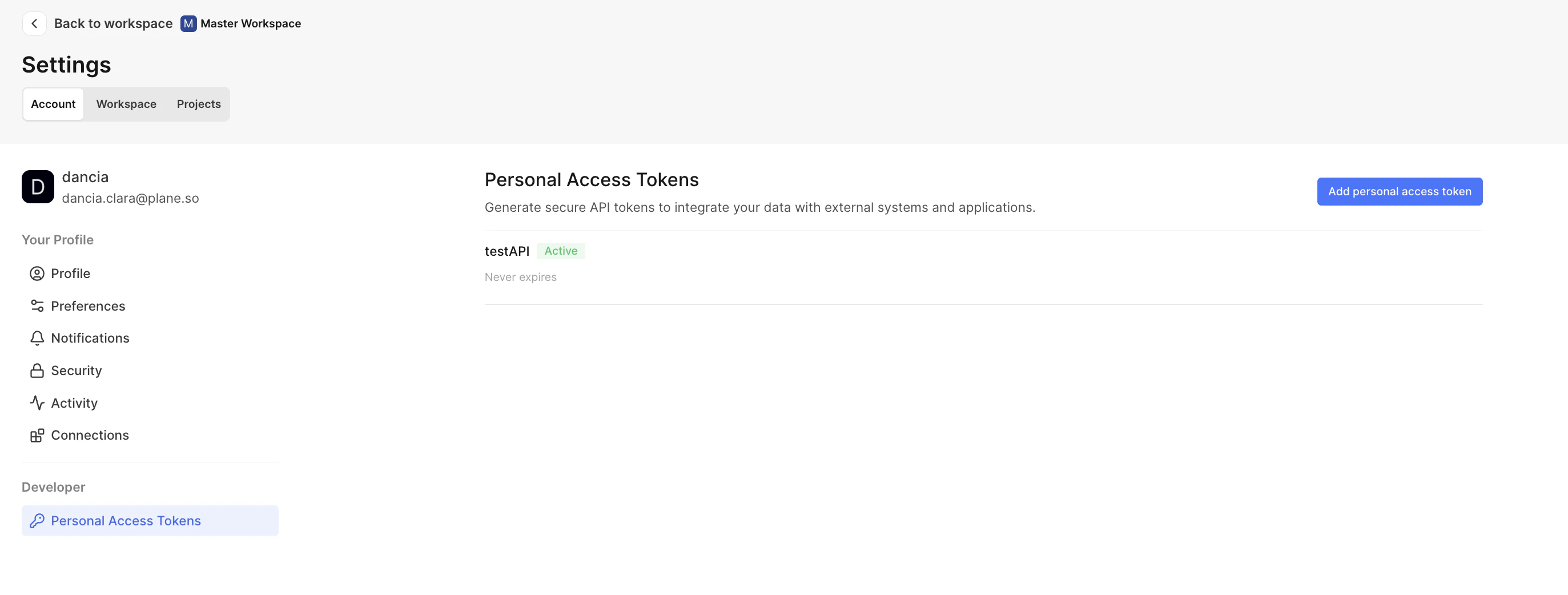
- Click
Add personal access token.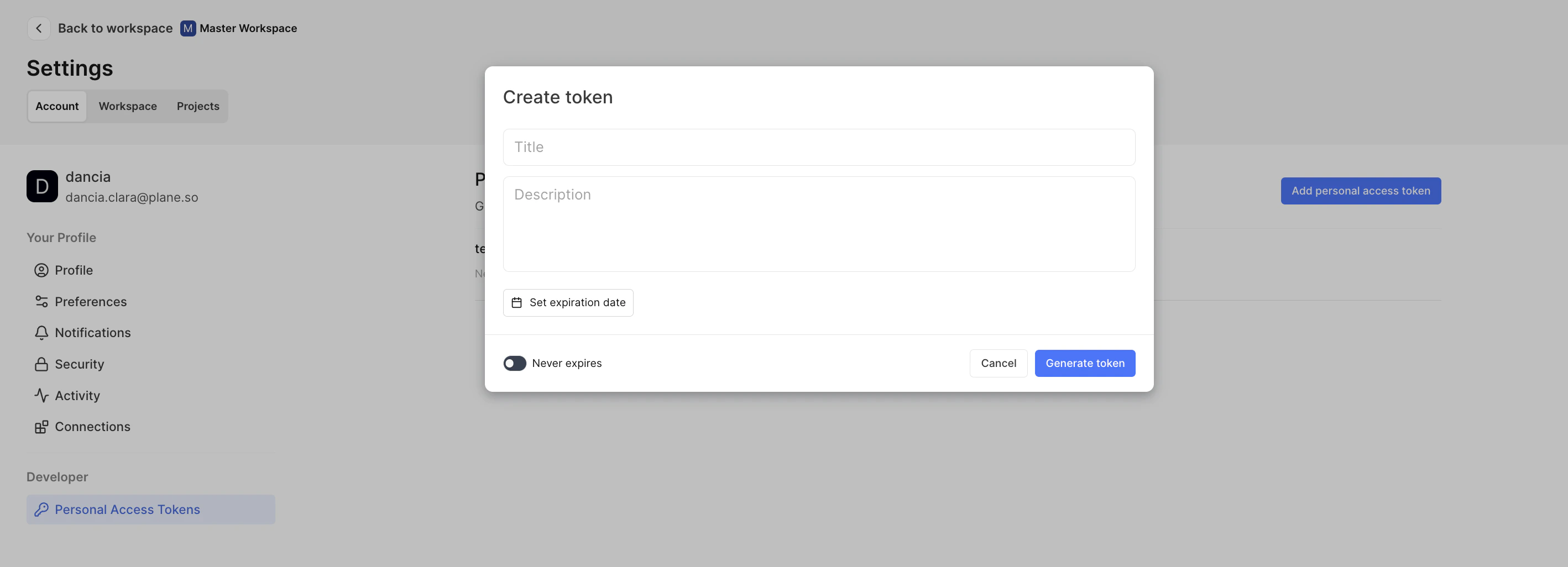
- Choose a title and description so you know why you are creating this token and where you will use is.
- Choose an expiry if you want this to stop working after a point.
Using the API Key
To authenticate an API request, include your API key in the request header:Example of an Authenticated API Request
Here’s an example of making a GET request to the API with the API key:Request
Response
Error Handling
- Missing API Key: If the
X-API-Keyheader is not included, the API will return an error indicating that authentication is required. - Invalid API Key: If the provided API key is invalid or expired, the API will return an error message indicating an authentication failure.
Security Recommendations
- Keep the API Key Secret: Treat your API key like a password. Do not share it or expose it in client-side code.
- Regenerate Key If Compromised: If you suspect that your API key has been compromised, generate a new one immediately and update your applications.
Status codes
HTTP Methods HTTP defines a set of request methods, also known as HTTP verbs, to indicate the desired action for a given resource. Given below is the list of methods commonly adopted by Plane’s APIs:
Given below is the list of the most commonly encountered success responses:
Error Response
Given below is the list of the most commonly encountered error responses:Pagination Documentation
Overview
This API implements a cursor-based pagination system, allowing clients to efficiently navigate through large datasets. The system uses a cursor parameter to manage the position and direction of pagination.Cursor Format
The cursor is a string formatted asvalue:offset:is_prev, where:
valuerepresents the page size (number of items per page).offsetis the current page number (starting from 0).is_previndicates whether the cursor is moving to the previous page (1) or to the next page (0).
Request Parameters
per_page(optional): Number of items to display per page. Defaults to 100. The maximum allowed value specified by the server is 100.cursor(optional): Cursor string to navigate to a specific page. If not provided, pagination starts from the first page.
Responses
The paginated response includes the following fields:next_cursor: Cursor string for the next page.prev_cursor: Cursor string for the previous page.next_page_results: Boolean indicating if there are more results after the current page.prev_page_results: Boolean indicating if there are results before the current page.count: Total number of items on the current page.total_pages: Estimated total number of pages.total_results: Total number of items across all pages.extra_stats: Additional statistics, if any.results: Array of items for the current page.
Request: Fetching the First Page
Response: First Page
Request: Fetching the Next Page
Response: Second Page
Error Handling
- Invalid Cursor Format: If the provided cursor string is not in the correct format, the API will respond with an error message indicating an invalid cursor format.
- Pagination Limits: Requests exceeding the maximum
per_pagelimit will receive an error response detailing the maximum allowed value.
Rate Limit
Overview
To ensure fair usage and maintain the quality of service for all users, our API implements rate limiting. Rate limiting restricts the number of requests a client can make within a certain time frame.Rate Limit Details
- Limit: Each client is limited to 60 requests per minute.
- Reset Interval: The rate limit counter resets every minute.
- Scope of Limitation: The rate limit applies to all requests made with a given API key.
Identifying Your Rate Limit Status
Rate limit status is communicated in the response headers of each API request:X-RateLimit-Remaining: The number of requests remaining in the current rate limit window.X-RateLimit-Reset: The time at which the current rate limit window resets (in UTC epoch seconds).
Fields and Expand Query Parameters
Our API provides flexible data retrieval capabilities through two powerful query parameters: fields and expand. These parameters allow clients to tailor the response data to their specific needs, optimizing both the payload size and the clarity of the response.Fields Parameter
Overview
The fields parameter enables clients to selectively retrieve only a subset of fields for a given resource. This is particularly useful for minimizing response size and bandwidth consumption, especially when the client requires only specific pieces of data.Usage
- The
fieldsparameter accepts a comma-separated list of field names that the client wants to be included in the response. - Syntax:
?fields=field1,field2,field3
id, name, and description fields of the resource.
Expand Parameter
Overview
The expand parameter allows clients to request additional related information to be included in the response. This is useful for retrieving detailed information about nested resources without making separate API calls.Usage
- The
expandparameter can be used to include details of related resources or nested objects in the response. - Syntax:
?expand=field1,field2
Example
assignees and state.
Error Handling
- Invalid or unrecognized field names passed in the
fieldsparameter will result in an error response, indicating which fields are invalid. - Similarly, if
expandis used on fields that cannot be expanded, an appropriate error message will be returned. import from “fs”